
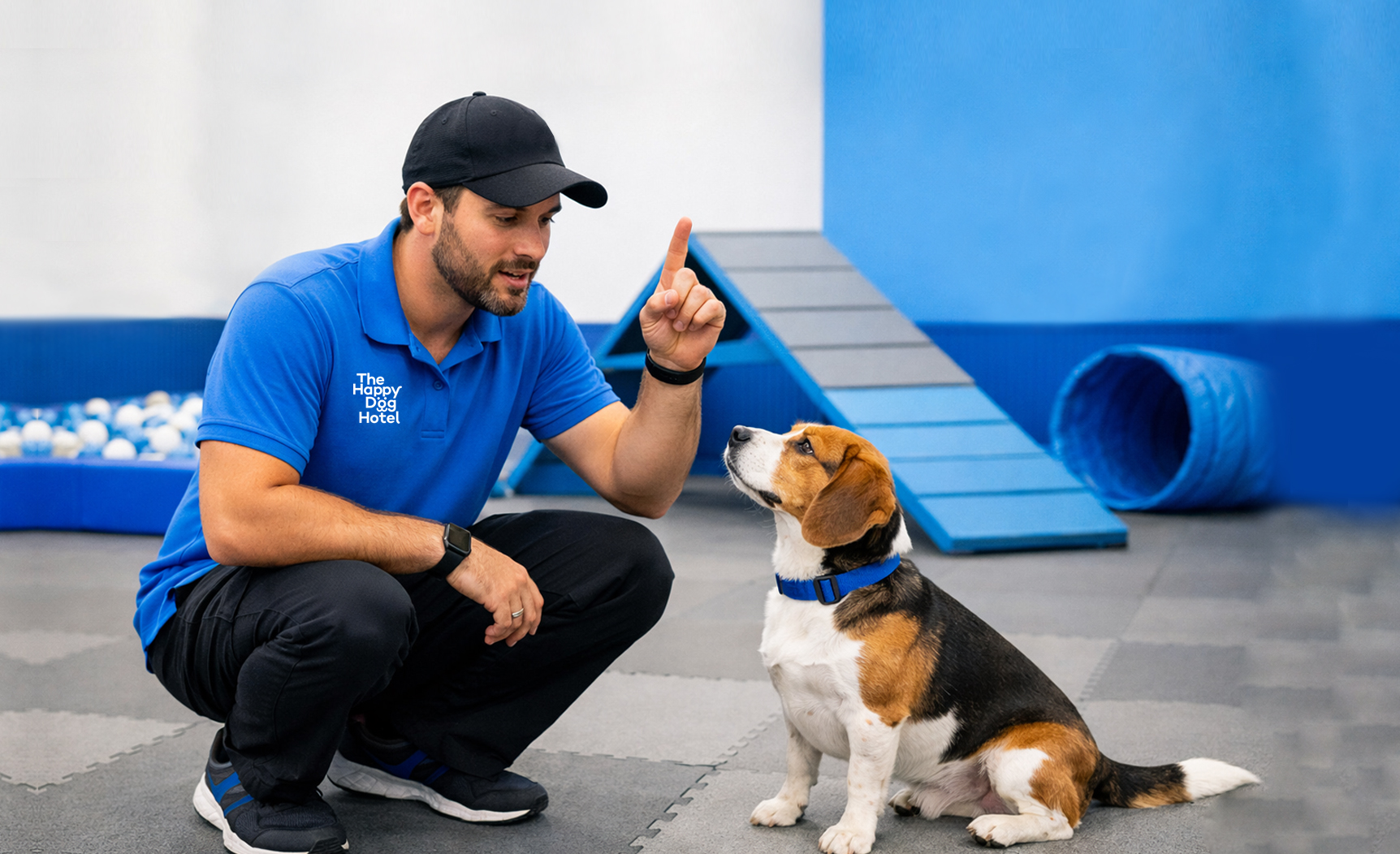
Place Training: How to Teach Your Dog to Settle on a Mat
- Posted: August 28, 2026
- By: Abram Wade Kendall
- Category: Uncategorized
- Comment: 0
If your dog seems to have endless energy, struggles to relax around guests, or follows you from room to room, place training can be a valuable skill to teach. The goal is simple: your dog learns that going to a designated mat or bed means it is time to settle, relax, and stay there until released.
For families looking for dog training in Johns Creek, place training can be especially useful for improving everyday manners and helping dogs learn how to manage excitement and impulses.
At The Happy Dog Hotel, training programs include foundational cues such as sit, stay, come, down, and place, along with focus work, leash manners, and real-world practice.
What Is Place Training?
Place training teaches your dog to go to a specific location—such as a mat, dog bed, or designated platform—and remain there calmly.
Unlike simply asking your dog to “sit,” place training gives your dog a clear physical boundary and a predictable behavior. Over time, your dog can learn that their mat is a comfortable place to relax even when something exciting is happening nearby.
– This can be helpful during:
– Family meals
– Visitors arriving at your home
– Cooking or household activities
– Doorbell excitement
– Busy family gatherings
– When you need your dog to settle down
– Quiet time after exercise or play
Why Is Place Training Important for Dogs?
Dogs naturally respond to their environment. A delivery person at the door, another dog outside, or an exciting visitor can quickly turn a calm dog into an overly excited one.
Place training gives your dog something specific to do instead of jumping, barking, pacing, or constantly seeking attention.
It also helps build impulse control. Rather than immediately reacting to everything around them, your dog learns to pause, focus, and wait.
For some dogs, this structured approach can make everyday situations much easier to manage.
How to Teach Your Dog to Settle on a Mat
1. Choose the Right Spot
Start with a comfortable mat or bed that your dog can easily recognize. Choose a quiet area with minimal distractions.
You don’t want to begin training in the middle of a chaotic environment.
2. Introduce the Mat
Place the mat on the floor and allow your dog to investigate it.
When your dog naturally steps onto the mat, reward the behavior with praise and a treat. Repeat this several times so your dog begins to associate the mat with positive experiences.
3. Add the “Place” Cue
Once your dog is willingly stepping onto the mat, introduce the verbal cue “place.”
Say the cue calmly and guide your dog toward the mat if necessary. As soon as all four paws are on the mat, reward your dog.
With repetition, your dog will begin connecting the word “place” with the action of going to the designated spot.
4. Build Duration Slowly
Don’t expect your dog to stay on the mat for 20 minutes on the first attempt.
Start with just a few seconds. Reward calm behavior, then gradually increase the amount of time your dog remains there.
If your dog gets up, calmly reset rather than turning the exercise into a battle.
5. Add Distractions
Once your dog understands the behavior, gradually introduce distractions.
You might:
– Walk around the room
– Sit nearby
– Open a door
– Pick up household items
– Have another person enter the room
– Increase the distance between you and your dog
The goal is to help your dog understand that “place” still means settle even when interesting things are happening.
6. Teach a Release Cue
Your dog should also learn when the exercise is finished.
Use a consistent release word such as “okay” or “free.” When you give the release cue, encourage your dog to leave the mat.
This creates a clear beginning and end to the behavior.
Common Place Training Mistakes
One of the biggest mistakes owners make is expecting too much too soon.
If your dog repeatedly gets up, the duration or distraction level may be too difficult. Go back to an easier step and build success again.
Another common mistake is rewarding only the act of getting onto the mat. Eventually, you want to reward calmness and duration, not just getting there.
Consistency is also important. Everyone in the household should use the same cue, expectations, and release word.
When Should You Consider Professional Dog Training?
Some dogs learn place training quickly, while others need more structured guidance.
If your dog struggles with impulse control, jumping, leash pulling, excessive excitement, or difficulty settling, working with a professional dog trainer in Johns Creek can help you create a training plan around your dog’s individual needs.
The Happy Dog Hotel’s offers personalized training options, including private one-on-one sessions, daycare-based Play & Train sessions, and a Board & Train program. Training can include place, basic obedience, leash manners, recall, impulse control, and confidence-building.
The team also emphasizes individualized goals and trainer feedback rather than taking a one-size-fits-all approach.
Build a Calmer, Better-Mannered Dog
Place training is more than teaching your dog to stand on a mat. It teaches an important life skill: how to settle and make a good choice even when the environment is exciting.
With short, consistent practice and positive reinforcement, many dogs can learn to recognize their place as a safe and relaxing spot.
If you’re searching for dog training near Johns Creek, The Happy Dog Hotel provides professional training in a structured environment designed around your dog’s needs. The facility is located at 11895 Jones Bridge Rd. #140, Johns Creek, GA 30005.
Call The Happy Dog Hotel at (404) 369-8512 to discuss your dog’s training needs.
Frequently Asked Questions
What is place training for dogs?
Place training teaches a dog to go to a designated mat, bed, or spot and remain there calmly until given a release cue. It is useful for building focus, impulse control, and relaxation.
How long does it take to teach a dog the place command?
It depends on the dog’s age, temperament, previous training, and consistency at home. Some dogs understand the basic concept quickly, while reliable duration and distraction-proofing can take considerably longer.
Is place training good for puppies?
Yes. Puppies can begin learning simple versions of place training using short sessions and frequent rewards. Keeping sessions brief helps prevent frustration and keeps learning positive.
Can place training help with a dog that jumps on guests?
It can help by giving the dog an alternative behavior when guests arrive. Instead of rushing toward the door, the dog can learn to go to its mat and remain there while the situation is managed.
Where can I find a professional dog trainer in Johns Creek?
The Happy Dog Hotel offers dog training in Johns Creek through its Pup Academy, with private training, Play & Train sessions, and Board & Train options.
Can older dogs learn place training?
Absolutely. Dogs can learn new behaviors at different ages. Training should be adjusted to the dog’s experience, motivation, physical abilities, and individual learning pace.
Hello, I am Kendall Abram Wade, the lead Dog Trainer at The Happy Dog Hotel. Animal training has been my lifelong pursuit, and I turned this passion into my full-time career in 2022. Dogs Thrive within a natural calm structure led by a calm, assertive owner who provides loving communication. By fulfilling your dog's essential needs and providing clear, consistent instruction, your pup will naturally learn your expectations. At The Happy Dog Hotel, my ultimate goal is to coach you and your best friend to become a confident team, ready to tackle the adventures of life together!





No Comments